


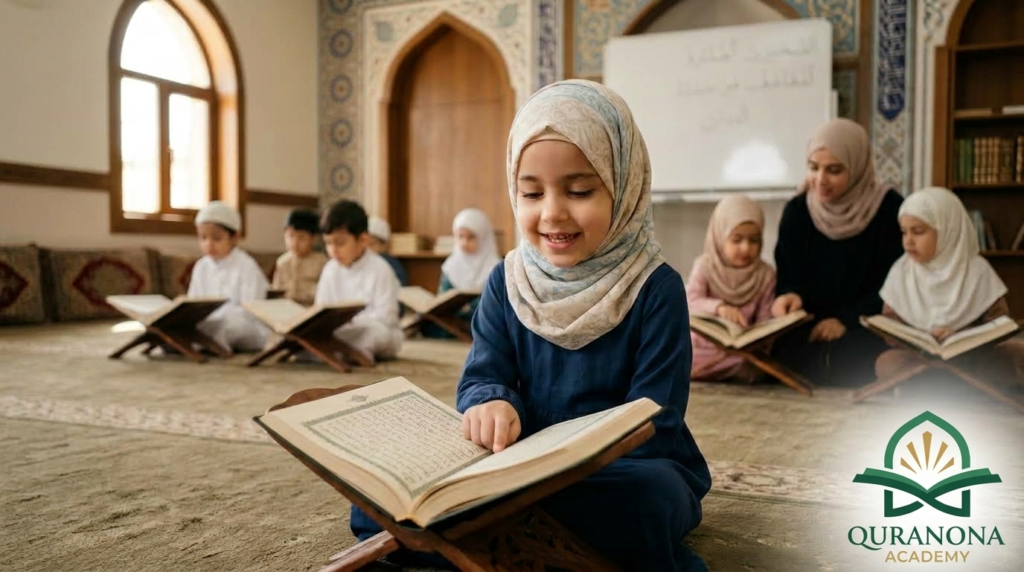
Somewhere between the toddler years and the first day of kindergarten, a lot of Muslim parents in the US, Canada, the UK, and Australia start asking the same quiet question: is it time yet? Should my three-year-old already be memorizing short surahs? Am I behind if my six-year-old still can’t recite Al-Fatiha on her own? Is there a “right” age, and if there is, who decides it?
It’s a question that comes up often in parenting groups, WhatsApp chats between moms, and late-night searches on a phone after the kids are finally asleep. Part of the pressure comes from seeing other children recite fluently at a young age. Part of it comes from simply wanting to do right by your child’s faith while living far from a strong Islamic community.
This article looks at what actually exists on this topic, starting with the honest answer: Islam does not set one specific age for starting Quran memorization. What we’ll cover instead is what scholars and experienced teachers actually rely on, how Arabic language learning and Quran memorization work well together, and a realistic, age-by-age path you can use at home, whatever stage your child is at right now.
- 1. Is There an “Official” Age in Islam to Start Memorizing Quran?
- 2. What the Age-Seven Hadith Actually Says (and Doesn’t Say)
- 3. Why Starting Early Still Matters
- 4. A Realistic, Age-by-Age Path
- 5. Why Teaching Arabic and Quran Together Works Best
- 6. Signs Your Child Is Actually Ready
- 7. Common Mistakes Parents Make With Timing
- 8. What If You’re Starting “Late”?
- 9. A Realistic Path for Kids Growing Up Abroad
- 10. How Quranona Academy Adapts to Your Child’s Age
- 11. Frequently Asked Questions
- 12. Conclusion
1. Is There an “Official” Age in Islam to Start Memorizing Quran?
Let’s start with the most honest answer possible: there is no verse in the Quran and no authentic hadith that names a specific age for beginning Quran memorization. This surprises a lot of parents, since so many Islamic parenting articles online talk about “the right age” as if it were a settled religious ruling.
What actually exists in the Sunnah is guidance about a related but different topic: teaching children to pray. That distinction matters, because conflating the two can create unnecessary pressure or guilt for parents whose children are progressing at a different pace.
Message Us on WhatsApp Book a Free Trial Class
2. What the Age-Seven Hadith Actually Says (and Doesn’t Say)
Many teachers and parents reference “age seven” as a general milestone in a child’s religious development. This comes from an authentic hadith, but it’s worth reading it carefully, since it’s specifically about the daily prayer, not Quran memorization.
Amr ibn Shu’ayb, from his father, from his grandfather, narrated: The Messenger of Allah ﷺ said, “Command your children to pray when they are seven years old, and discipline them for it when they are ten, and separate their beds.”
📚 Source: Sunan Abi Dawud, Hadith 495 (graded Hasan) | sunnah.com
This hadith gives us something genuinely useful, even though it isn’t directly about Hifz (Quran memorization): it shows that Islam treats age seven as a meaningful point of increased readiness and responsibility in a child’s religious life. Many experienced Quran teachers use this same general age range as a practical benchmark for starting more structured memorization, not because a hadith requires it, but because it reflects real developmental readiness that lines up with what child development also tells us.
Before age seven, most children can absolutely engage with the Quran in age-appropriate ways, listening, repeating short phrases, and building familiarity, but expecting the same structured, independent memorization you’d expect from an older child isn’t usually realistic, and it isn’t religiously required either.
3. Why Starting Early Still Matters
Even without a fixed age requirement, starting early carries real value, and the Quran and Sunnah give us plenty of reason to take this seriously at whatever age your child is ready.
Uthman ibn Affan, may Allah be pleased with him, narrated: The Prophet ﷺ said, “The best among you is the one who learns the Quran and teaches it.”
📚 Source: Sahih al-Bukhari, Hadith 5027 | sunnah.com
Early childhood is also when the brain is unusually good at absorbing new sounds and language patterns, something educators and linguists widely agree on. This is part of why many Quran teachers encourage early listening and exposure, well before formal memorization starts, since it builds a foundation that makes later memorization noticeably easier.
That said, “early” doesn’t mean “rushed.” A three-year-old who listens happily to short surahs during car rides is building something valuable, even if they can’t yet recite a single verse independently.
4. A Realistic, Age-by-Age Path
Instead of one fixed starting age, it helps to think in stages. Every child moves through these at a different pace, and that’s normal.
| Age Range | What’s Realistic | Focus |
|---|---|---|
| 0–3 years | Passive listening, repeated exposure | Familiarity with sounds, not memorization |
| 3–5 years | Repeating short phrases, simple surahs by ear | Listening + playful repetition |
| 5–7 years | Letter recognition, first independent memorization | Reading foundations + short surahs |
| 7–10 years | Structured memorization sessions, basic Tajweed | Consistency and correct pronunciation |
| 10+ years | Faster progress due to stronger focus and reading skills | Deeper memorization and understanding |
Notice that structured memorization doesn’t really begin until the reading foundation is in place. Trying to skip straight to memorization before a child can recognize letters often leads to frustration for both parent and child, and it isn’t necessary.
Book a Free Trial Class for Your Child
5. Why Teaching Arabic and Quran Together Works Best
One of the most common questions from parents raising kids abroad is whether to teach Arabic first and Quran memorization later, or the other way around. In practice, teaching kids Arabic and Quran together tends to work better than treating them as two separate, sequential subjects.
Here’s why: Quran memorization relies heavily on recognizing Arabic letters, their shapes, and their sounds. A child who is also learning basic Arabic language skills, even simple vocabulary and letter recognition, builds a stronger foundation for accurate recitation than a child memorizing purely by ear with no letter recognition at all.
At the same time, regular exposure to Quranic Arabic naturally reinforces language learning. Children start recognizing patterns, common words, and sounds that show up again in basic Arabic conversation. This is especially valuable for Muslim kids growing up abroad, where Arabic often isn’t spoken at home or in daily life outside of Quran class.
This doesn’t mean a child needs to be fluent in conversational Arabic before starting Quran lessons. It means the two skills reinforce each other far more effectively when taught side by side, rather than waiting for one to be “finished” before starting the other.
5b. What General Child Development Research Adds to the Picture
Outside of religious sources, general child development research offers a useful, complementary perspective, and it’s worth being clear that this is educational guidance, not Islamic ruling. Language researchers widely note that early childhood, roughly ages one through six, is a period when children absorb new sounds and language patterns unusually well, a window sometimes referred to as a sensitive period for language acquisition.
This is part of why listening-based exposure to Quranic recitation from a young age tends to pay off later, even before a child begins any formal memorization. The unfamiliar sounds of Arabic, letters like ع, ح, or ق, that don’t exist in English, become far more natural to pronounce correctly when a child’s ear has already been trained through years of casual listening.
At the same time, developmental psychologists generally note that sustained attention and working memory, both essential for structured memorization, continue maturing well into the early elementary years. This lines up closely with what experienced Quran teachers observe in practice: structured, independent memorization sessions tend to go more smoothly once a child is around five to seven years old, not because of a fixed rule, but because the underlying cognitive skills are more developed by then.
6. Signs Your Child Is Actually Ready
Instead of counting candles on a birthday cake, it’s more useful to look for practical readiness signs. These tend to matter more than age alone.
- Attention span: Can your child sit and focus on one activity for 10 to 15 minutes without constant redirection?
- Verbal repetition: Can they repeat a short phrase back accurately after hearing it a few times?
- Interest, even briefly: Do they show curiosity or engagement during Quran listening time, even if it’s not constant?
- Following simple instructions: Can they follow a two-step instruction, like “listen, then repeat”?
- Basic letter familiarity: For structured memorization specifically, some familiarity with Arabic letters makes the process much smoother, though it’s not an absolute requirement to begin exposure.
A child who shows most of these signs is likely ready for more structured sessions, regardless of whether they just turned four or are already seven.
7. Common Mistakes Parents Make With Timing
A few patterns come up again and again with well-meaning parents, and knowing them ahead of time can save a lot of frustration.
- Starting formal memorization too early. Pushing structured Hifz sessions on a two-year-old usually leads to frustration rather than progress. Listening and exposure are enough at this stage.
- Comparing your child to others. Every child develops differently. A cousin or classmate who started earlier or progressed faster isn’t a fair measuring stick.
- Waiting for “perfect” Arabic before starting anything. As covered above, Arabic and Quran learning work best together, not one after the other.
- Treating age seven as a religious deadline. As we clarified earlier, that age comes from a hadith about prayer, not a requirement for Quran memorization specifically.
- Giving up after a slow start. A rocky first few weeks doesn’t mean a child isn’t ready. Sometimes it just means the format or pace needs adjusting.
8. What If You’re Starting “Late”?
If your child is already eight, nine, ten, or older and hasn’t started memorizing yet, there is genuinely no cause for guilt. There is no upper age limit in Islam for beginning Quran memorization, and in many cases, older children actually progress faster than younger ones, since their reading skills, focus, and comprehension are more developed.
Many strong huffaz (those who have memorized the Quran) didn’t begin until later childhood or even their teenage years. What matters far more than the starting age is consistency once you begin.
9. A Realistic Path for Kids Growing Up Abroad
For Muslim families in the US, Canada, the UK, and Australia, there’s an added layer to this question: Arabic often isn’t spoken at home, mosques may be far away, and school schedules leave limited time. A realistic approach accounts for this reality rather than ignoring it.
Short, consistent sessions, even 15 minutes a day, tend to work far better than occasional long sessions squeezed in on weekends. Pairing basic Arabic language exposure with Quran listening from a young age also helps reduce the feeling that Quran class is a separate, disconnected subject from daily life.
It also helps to involve a qualified teacher early, particularly one experienced in teaching non-Arabic-speaking children abroad, since they can adjust pace and methods in ways that are hard to replicate through general parenting alone.
Weekend Islamic schools remain a valuable community resource for many families, but a once-a-week, group-based format isn’t always ideal for the earliest stages of Quran learning, when a child benefits most from individual pacing and immediate correction of pronunciation. This is often why families supplement weekend programs with more frequent, shorter one-on-one sessions during the week, especially in the readiness-building years before structured Hifz begins.
Time zones and after-school schedules are also a real, practical concern for families abroad, not a minor detail. A learning plan that ignores homework loads, extracurricular activities, and normal childhood tiredness by evening is unlikely to stick, no matter how well-designed the curriculum is on paper. Flexible scheduling, built around your family’s actual week rather than a fixed weekly time slot, tends to hold up much better over months and years.
Book a Free Trial Class Ask Us on WhatsApp
9b. What About Siblings at Different Ages?
Many parents ask whether siblings at different stages should learn together or separately. In practice, a mixed approach often works best. Shared family listening time, playing recitation during breakfast or car rides, works well across ages, since even an older sibling benefits from repeated exposure while a younger one simply absorbs the sounds.
Structured, individual sessions, however, generally work better one-on-one rather than grouped, since a five-year-old and a nine-year-old are realistically at very different stages of readiness and pace. Trying to teach both at the same level in the same session usually slows down the older child while overwhelming the younger one. Separate, age-appropriate sessions, even if shorter, tend to produce steadier progress for both.
10. How Quranona Academy Adapts to Your Child’s Age
Rather than applying one fixed curriculum to every child regardless of age, Quranona Academy’s 1-on-1 classes are built around your child’s actual stage of development. A four-year-old just starting to listen and repeat needs a very different approach than a nine-year-old beginning structured Hifz for the first time.
Our qualified, native Arabic-speaking teachers work with children individually, combining Arabic language foundations with Quran memorization and Tajweed in a way that fits your child’s pace, not a generic timeline. Whether your child is just starting to show interest or is ready for consistent daily memorization, the starting point is shaped around them.
Book Your Free Trial Class Now
11. Frequently Asked Questions
Is there a hadith that says exactly when a child should start memorizing Quran?
No. There is no authentic hadith that sets a specific age for starting Quran memorization. The well-known hadith about age seven refers to teaching children the prayer (salah), not Quran memorization specifically. Scholars and teachers rely on general readiness signs instead of a fixed religious age requirement.
Is 3 years old too young to start Quran memorization?
Age 3 is generally too young for structured memorization, but it’s a great age for listening, repetition, and simple exposure to short surahs. Most teachers recommend structured memorization once a child can sit, focus, and repeat words back reliably, often somewhere between ages 4 and 6.
What if my child is already 9 or 10 and hasn’t started memorizing yet?
That’s completely fine. There is no upper age limit in Islam for beginning Quran memorization, and children this age often progress faster than younger ones because their reading and focus skills are already more developed.
Should I teach my child Arabic first, or Quran memorization first?
They work best together rather than one before the other. Basic Arabic letter recognition supports accurate Quran reading, while regular Quran exposure builds familiarity with Arabic sounds and vocabulary. Most teachers introduce both side by side rather than waiting for full Arabic fluency first.
How do I know if my child is actually ready to start memorizing Quran?
Look for practical signs rather than a specific birthday: your child can sit and focus for 10 to 15 minutes, can repeat short phrases accurately, shows some interest during Quran listening time, and can follow simple two-step instructions.
12. Conclusion: There’s No Deadline, Only a Starting Point
If you’ve been feeling behind, or worried that your child started “too late” or that you started them “too early,” it’s worth repeating the honest answer one more time: Islam doesn’t set a fixed age for Quran memorization to begin. What matters is readiness, consistency, and an approach that fits your specific child, not a race against other families or a number attached to a birthday.
Whether your child is three and just starting to listen, six and ready for their first short surah, or ten and beginning structured Hifz for the first time, the right moment to start is simply when they show real readiness, supported by patient, consistent teaching. At Quranona Academy, we work with children at every stage, combining Arabic language foundations with Quran memorization through flexible, 1-on-1 online classes with qualified, native Arabic-speaking teachers.
Book a Free Trial Class Now Contact Us Directly on WhatsApp
🌐 Visit Quranona Academy’s Website
- Sunan Abi Dawud, Hadith 495 (graded Hasan) — narration of Amr ibn Shu’ayb, on commanding children to pray at age seven — sunnah.com
- Sahih al-Bukhari, Book of the Virtues of the Quran, Hadith 5027 — narration of Uthman ibn Affan, “The best among you is the one who learns the Quran and teaches it” — sunnah.com
