



How to Motivate a Child to Memorize Quran: 7 Teacher-Tested Methods
- Why Does a Child Refuse to Memorize the Quran?
- The Goal Is Not Just Memorization
- 7 Teacher-Tested Methods to Motivate a Child
- What Parents Should Avoid
- A Simple Weekly Quran Memorization Routine
- When Should You Consider One-on-One Quran Classes?
- Final Takeaway
- Frequently Asked Questions (FAQs)
- Author Bio
- Sources & References
Your Child Refuses to Memorize Quran? Start Here
Your child says, “I don’t want to memorize Quran.”
You ask again.
They complain.
You remind them.
They become frustrated.
Soon, a simple Quran session turns into an argument between parent and child.
If this sounds familiar, you may be wondering:
“How can I motivate my child to memorize Quran without turning every lesson into a struggle?”
The answer may not be to push harder. Sometimes, a child’s resistance is a signal that something about the experience needs to change. The memorization target may be too difficult, the session may be too long, the child may be afraid of making mistakes, or Quran time may have gradually become associated with pressure.
This does not mean that children should never be expected to learn Quran. Parents have an important role in teaching their children and helping them develop a lifelong relationship with the Book of Allah. But the way we teach matters.
Allah says:
ٱدْعُ إِلَىٰ سَبِيلِ رَبِّكَ بِٱلْحِكْمَةِ وَٱلْمَوْعِظَةِ ٱلْحَسَنَةِ “Invite to the way of your Lord with wisdom and good instruction…”
Quran 16:125
The verse establishes a principle of wisdom and good instruction in calling people toward goodness. The Prophet ﷺ also taught an important principle:
«يَسِّرُوا وَلاَ تُعَسِّرُوا، وَبَشِّرُوا وَلاَ تُنَفِّرُوا» “Make things easy for the people and do not make it difficult for them, and give them glad tidings and do not repulse them.”
Sahih al-Bukhari 6125
So when a child struggles with Quran memorization, the first question should not always be: “How do I make my child try harder?”
A better question is: “What can I change so that my child can learn consistently, confidently, and with love for the Quran?”
Why Does a Child Refuse to Memorize the Quran?
Before changing the routine, try to understand the resistance. Children rarely say exactly what is bothering them.
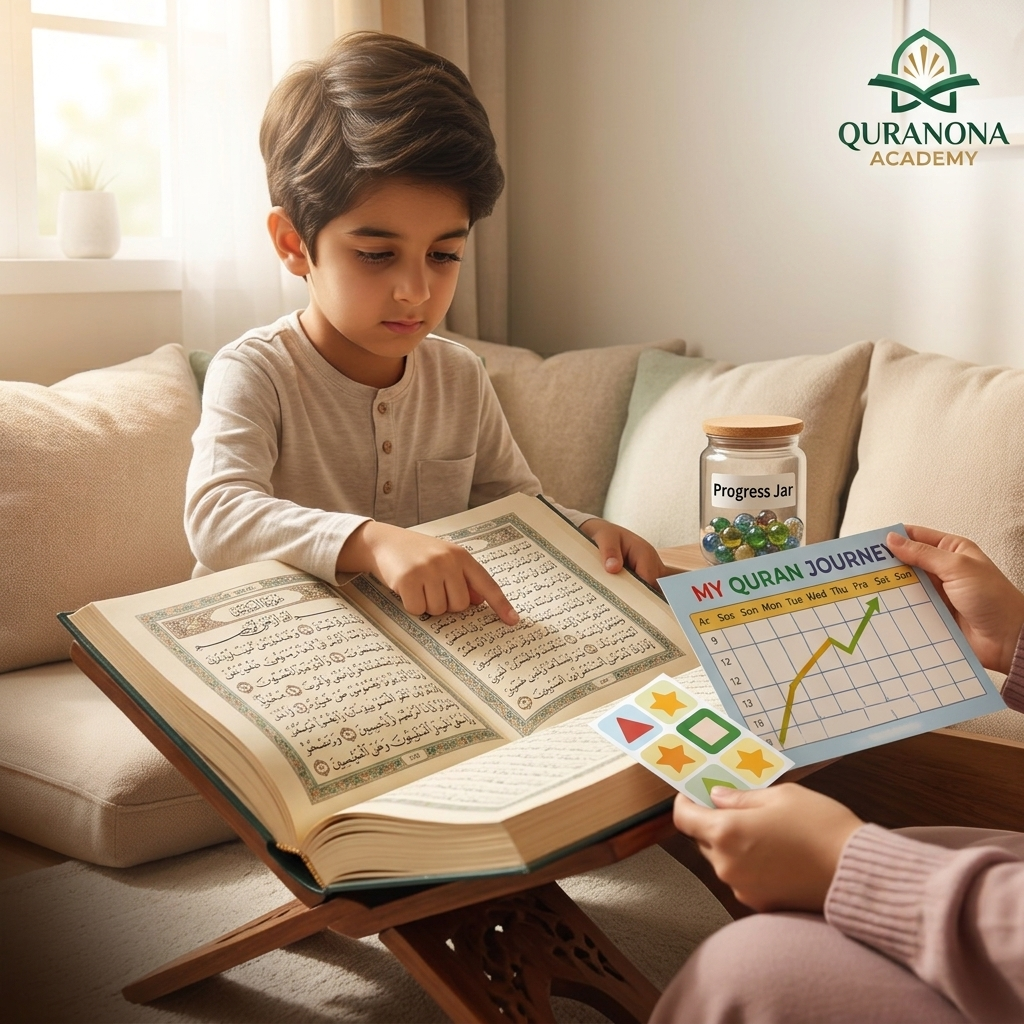
A child who says: “I hate memorizing Quran” may actually mean:
- “It is too difficult.”
- “I’m scared of making mistakes.”
- “I’m tired.”
- “I don’t understand what I’m memorizing.”
- “I feel like I can never do it as well as my brother.”
- Or simply: “I don’t enjoy the way these sessions are happening.”
That distinction matters. If the underlying problem is difficulty, increasing pressure may make the situation worse. If the problem is boredom, giving the child an even longer memorization session is unlikely to solve it. If the problem is lack of confidence, repeatedly pointing out mistakes may increase anxiety rather than motivation.
The first step in effective Quran memorization for kids is therefore diagnosis before correction. Ask your child calmly:
- What part of Quran time do you dislike?
- Is memorizing difficult for you?
- Do you understand what the verses mean?
- Do you feel tired when we start?
- Is there something about the lesson that makes you nervous?
- Would you prefer shorter sessions?
- What would make Quran time easier for you?
The Goal Is Not Just Memorization
It is easy for parents to focus entirely on numbers: “How many pages did my child memorize?” But Quran education is bigger than a memorization target. We want children to:
- Recite the Quran correctly.
- Develop familiarity with its words and meanings.
- Learn proper Tajweed gradually.
- Respect the Quran.
- Enjoy listening to and reciting it.
- Develop consistency.
- Build a lifelong relationship with Allah’s Book.
Allah says:
وَلَقَدْ يَسَّرْنَا ٱلْقُرْءَانَ لِلذِّكْرِ فَهَلْ مِن مُّدَّكِرٍ “And We have certainly made the Qur’an easy for remembrance, so is there any who will remember?”
Quran 54:17
This verse gives parents encouragement: Quran memorization is a noble goal, and Allah has made the Quran accessible for remembrance. The challenge is often finding a sustainable way for a particular child to approach it.
7 Teacher-Tested Methods to Motivate a Child to Memorize Quran
Method 1: Find the Real Reason Behind the Resistance
The first method is simple: Do not treat every refusal as laziness. A child may resist because the task feels overwhelming. Imagine asking a child to memorize an entire page when they are still struggling with a few lines. From the parent’s perspective, the assignment may seem reasonable. From the child’s perspective, it may feel impossible.
Break the problem down. Instead of asking: “Why haven’t you memorized the page?” try: “Which ayah feels difficult?” Then work on that specific part.
A useful rule: Behavior is information. Resistance does not automatically mean disobedience. Sometimes it tells you that the method, timing, workload, or learning environment needs adjustment.
Method 2: Stop Turning Quran Time Into a Battle
One of the biggest mistakes parents can make is allowing Quran time to become a daily confrontation. The parent becomes more frustrated, the child becomes more resistant, the session becomes longer, everyone leaves unhappy, and the next session becomes even harder.

This is exactly why gentleness is such an important principle. The Prophet ﷺ said:
«إِنَّ اللَّهَ رَفِيقٌ يُحِبُّ الرِّفْقَ» “Allah is kind and He loves kindness…”
Sahih Muslim 2593
Gentleness does not mean abandoning expectations. It means teaching without unnecessary harshness. There is a difference between: “You have to finish this page before you can do anything else” and: “Let’s work on these three ayahs first, then we’ll see how you’re doing.”
Method 3: Make the Memorization Goal Smaller
Large goals can discourage children. Small goals can create momentum. Instead of saying: “Memorize one whole page today”, try: “Let’s master these two ayahs.” Once the child succeeds, acknowledge the achievement. Then move forward gradually.
You can divide each session into:
Review → New Memorization → Review Again
- 5 minutes: review previously memorized verses.
- 10 minutes: learn a small new section.
- 5 minutes: recite the new section again.
- 2 minutes: celebrate the completed goal.
Method 4: Give Your Child Limited Choices
Children naturally want some sense of independence. That does not mean allowing them to decide whether Quran learning happens at all. Instead, give them limited choices inside a structured routine:
- “Would you like to review Surah Al-Falaq first or Surah An-Nas?”
- “Would you like to recite first or listen to the ayah first?”
- “Would you rather have your Quran session before dinner or after dinner?”
Method 5: Connect Memorization With Meaning
Memorization becomes more meaningful when the child understands what they are reciting. Suppose a child is memorizing a short surah. Instead of spending the entire lesson on repetition alone, take a moment to explain:
- What is this surah about?
- What does this word mean?
- What lesson can we learn?
- How does this verse relate to our daily life?
Method 6: Find the Right Teacher and Teaching Method
Sometimes the problem is not that a child refuses Quran. The problem may be that the current teaching approach does not fit the child. Different children respond differently to teachers.
This is why a good Quran teacher needs more than Quran knowledge. They need patience, communication skills, and the ability to understand the learner. A one-on-one Quran class can be especially helpful because the teacher can adapt the pace to the individual child.

Method 7: Build Consistency Without Chasing Perfection
One of the most important lessons for parents is this: Consistency matters more than having a perfect day. There will be days when your child is tired or busy. Do not interpret every difficult day as failure. Instead, return to the routine.
What Parents Should Avoid
- Constant Comparison: Avoid comparing your child to cousins or peers. Compare their progress only to their own past performance.
- Using Shame as Motivation: Avoid humiliating a child for forgetting. Forgetting is a natural part of learning.
- Making Every Session Too Long: Long, exhausting sessions lead to burnout. Short and focused is better.
- Focusing Only on New Memorization: Always balance new learning with continuous review.
- Turning Every Mistake Into a Crisis: Treat mistakes as learning opportunities rather than failures.
A Simple Quran Memorization Routine for Children
- Step 1: Choose a Consistent Time: Pick a time when the child is alert, not exhausted.
- Step 2: Start With Revision: Begin with familiar verses to build confidence.
- Step 3: Introduce a Small New Portion: Keep targets realistic and achievable.
- Step 4: Listen Carefully: Identify whether mistakes stem from memory, Tajweed, or focus.
- Step 5: End Positively: Finish on a successful recitation to leave a good impression.
When Should You Consider One-on-One Quran Classes?
If you have tried changing the routine at home but your child continues to resist, consider whether the learning environment needs to change. Children often respond differently to a dedicated teacher than to a parent.
Final Takeaway: Motivation Starts With Understanding
When a child refuses to memorize Quran, the answer is not always more pressure. Sometimes the child needs a smaller goal, a shorter session, more revision, better timing, or a more suitable teacher. The Quran deserves to be taught with seriousness, but seriousness does not require unnecessary harshness.
Instead of asking: “How do I make my child memorize more?” ask: “How can I help my child learn Quran correctly, consistently, and with a heart that remains connected to it?”
Frequently Asked Questions (FAQs)
My child cries every time we start Hifz time. Should I force them to stay?
No. Forcing a crying child to recite Quran builds a traumatic association between emotional pain and the Book of Allah. When tears start, immediately stop the formal memorization session. De-escalate the emotion with a hug, offer a glass of water, and ask them gently what feels hard. Switch to playing a beautiful recitation in the background or telling them a story from the Quran instead. Resume short micro-sessions only when they are calm.
What is the ideal age for a child to start Quran memorization?
While formal reading and Tajweed usually start around ages 5 to 7, informal auditory exposure should begin in infancy. Between ages 3 and 5, children can easily pick up short Surahs like Al-Fatiha, Al-Ikhlas, and Al-Nas purely through listening to their parents or audio recitations. Never push heavy formal reading before a child has mastered basic Arabic letter recognition (Al-Qaida Al-Nooraniah).
How long should a daily Quran session be for a 7-year-old?
For a 7-year-old child attending school full-time, the ideal daily Quran session should be between 15 to 20 minutes maximum. High consistency with short duration yields far better retention and emotional well-being than a stressful one-hour session once a week.
My child memorizes fast but forgets quickly. How do I fix this?
Fast memorizers often rely on short-term auditory memory without establishing visual or structural anchors. Fix this by slowing down their daily intake and implementing a strict 3-tier review system: Daily Revision (yesterday’s lesson), Recent Revision (the last 5 pages), and Cumulative Revision (older Juz’). Ensure review always takes priority over learning new verses.
How can online Quran classes help if my child already resists learning at home?
Online 1-on-1 classes introduce a fresh, exciting dynamic. Professional tutors use interactive digital whiteboards, screen sharing, and structured praise systems that make lessons feel like engaging online activities rather than home chores. Furthermore, children respond differently to dedicated teachers, removing the emotional friction that often exists between parents and kids. You can explore structured 1-on-1 plans tailored to your child at Quranona Academy.
Give Your Child the Gift of Loving the Quran
Don’t let daily Quran practice turn into a struggle at home. At Quranona Academy, our certified, native Arabic teachers specialize in gentle, interactive 1-on-1 lessons designed specifically for children of all levels.
Book a Free Trial Class at Quranona Academy →💬 Have questions or prefer direct booking?
Chat Directly on WhatsApp: +20 150 585 2965 →Sources and References
Quran:
- Surah An-Nahl 16:125 — Wisdom and good instruction in calling to the way of Allah.
- Surah Al-Qamar 54:17 — Allah’s statement that He has made the Quran easy for remembrance.
- Surah Taha 20:114 — The supplication: “My Lord, increase me in knowledge.”
Sunnah:
- Sahih al-Bukhari 6125 — “Make things easy… and do not repulse them.”
- Sahih Muslim 2593 — Allah loves gentleness.
- Sunan Abi Dawud 4807 — Allah loves gentleness in all matters.
Editorial Note: The practical teaching recommendations in this article are presented as educational guidance and are not claimed to be direct Sunnah prescriptions unless explicitly supported by the cited Quranic or hadith evidence.
