

Last Updated: September 12, 2026
Ask ten people learning Arabic for the Quran which Arabic they should start with, and you’ll likely get ten different answers. Some insist Modern Standard Arabic (MSA) is the essential foundation. Others say it’s a waste of time and you should go straight to Quranic Arabic. Both camps sound confident, and that’s exactly the problem: nobody explained the actual difference first.
This guide breaks down what Quranic Arabic and Modern Standard Arabic really are, how different they actually are from each other, and which one makes sense for your specific goal.
- 1. Why This Question Confuses So Many Learners
- 2. What Modern Standard Arabic Actually Is
- 3. What Quranic Arabic Actually Is
- 4. Why the Quran Describes Itself as “Clear Arabic”
- 5. Key Differences at a Glance
- 6. Can Someone Who Knows MSA Understand the Quran?
- 7. Which Should You Learn First?
- 8. How Learning Quranic Arabic Actually Works
- 9. Common Mistakes Learners Make
- 10. Common Misconceptions
Why This Question Confuses So Many Learners
Part of the confusion comes from the word “Arabic” being used as if it refers to one single, uniform language. In reality, a fluent MSA news anchor and a scholar trained specifically in Quranic Arabic have studied two related but distinct forms of the same language family, each shaped by a different purpose.
The other source of confusion is well-meaning advice that oversimplifies things. “Learn MSA first, it’s the foundation” sounds reasonable, but it can send someone down a two-year path of grammar drills and news vocabulary when their actual goal was simply to understand Surah Al-Baqarah.
There’s also a naming problem. Some textbooks call everything “Classical Arabic,” others say “Fusha” to mean both MSA and Quranic Arabic interchangeably, and native speakers often use these terms loosely in conversation. Without clear definitions, it’s easy to think you’re choosing between two options when you don’t actually know what each one includes.
What Modern Standard Arabic Actually Is
Modern Standard Arabic is the standardized form of Arabic used across the Arab world today for news broadcasts, official documents, textbooks, and formal speeches. It developed from Classical Arabic over the past two centuries as a practical, unified written language that any educated Arabic speaker, regardless of their local dialect, can read and understand.
MSA vocabulary leans toward modern life: politics, technology, current events, and everyday formal communication. Nobody grows up speaking MSA at home; it’s learned in school and used in writing and formal contexts, while daily conversation happens in regional dialects like Egyptian, Levantine, or Gulf Arabic.
What Quranic Arabic Actually Is
Quranic Arabic, often called Classical Arabic in this context, is the form of Arabic in which the Quran was revealed roughly 1,400 years ago. Unlike MSA, it hasn’t been simplified or modernized, because the text it belongs to has never changed a single letter since revelation.
This form of Arabic carries a wider vocabulary range, more varied sentence structures, and rhetorical techniques rarely used in everyday MSA writing today. Words in the Quran often carry layered meanings that classical scholars have written entire volumes explaining, a depth that modern news Arabic simply doesn’t need or use.
A simple example: the word “سيارة” (car) is pure MSA vocabulary, since cars didn’t exist in the 7th century. Meanwhile, a Quranic word like “الصِّرَاط” (the path) carries theological weight and appears across dozens of verses with commentary spanning centuries, something no MSA word needs to carry. Neither form of Arabic is “better” than the other; they were simply built to do different jobs.
Why the Quran Describes Itself as “Clear Arabic”
Quran, Surah Ash-Shu’ara 26:195
بِلِسَانٍ عَرَبِيٍّ مُّبِينٍ
“In a clear Arabic language.”
This verse, along with similar verses elsewhere in the Quran, is often cited by scholars to explain that the revelation came in a language the original audience could genuinely understand, rich and eloquent, but not deliberately obscure or riddle-like. That said, “clear” to native seventh-century Arabic speakers doesn’t mean “simple” by today’s standards. The richness of classical vocabulary and structure is exactly what makes dedicated study worthwhile for someone learning it centuries later and in a different linguistic environment.
If you’d like guidance on which Arabic path fits your goal, you can book a free trial class with Quranona Academy.
Key Differences at a Glance
| Aspect | Modern Standard Arabic | Quranic (Classical) Arabic |
|---|---|---|
| Primary use | News, education, formal writing today | The Quran and classical texts, unchanged since revelation |
| Vocabulary | Modern, everyday formal topics | Broader, layered, often poetic vocabulary |
| Sentence structure | More standardized and simplified | More varied, with rhetorical and literary devices |
| Who uses it | Media, students, professionals across the Arab world | Studied specifically for Quran, hadith, and classical scholarship |
| Grammar system | Same core grammar (Nahw and Sarf) | Same core grammar, applied with more complexity |
Can Someone Who Knows MSA Understand the Quran?
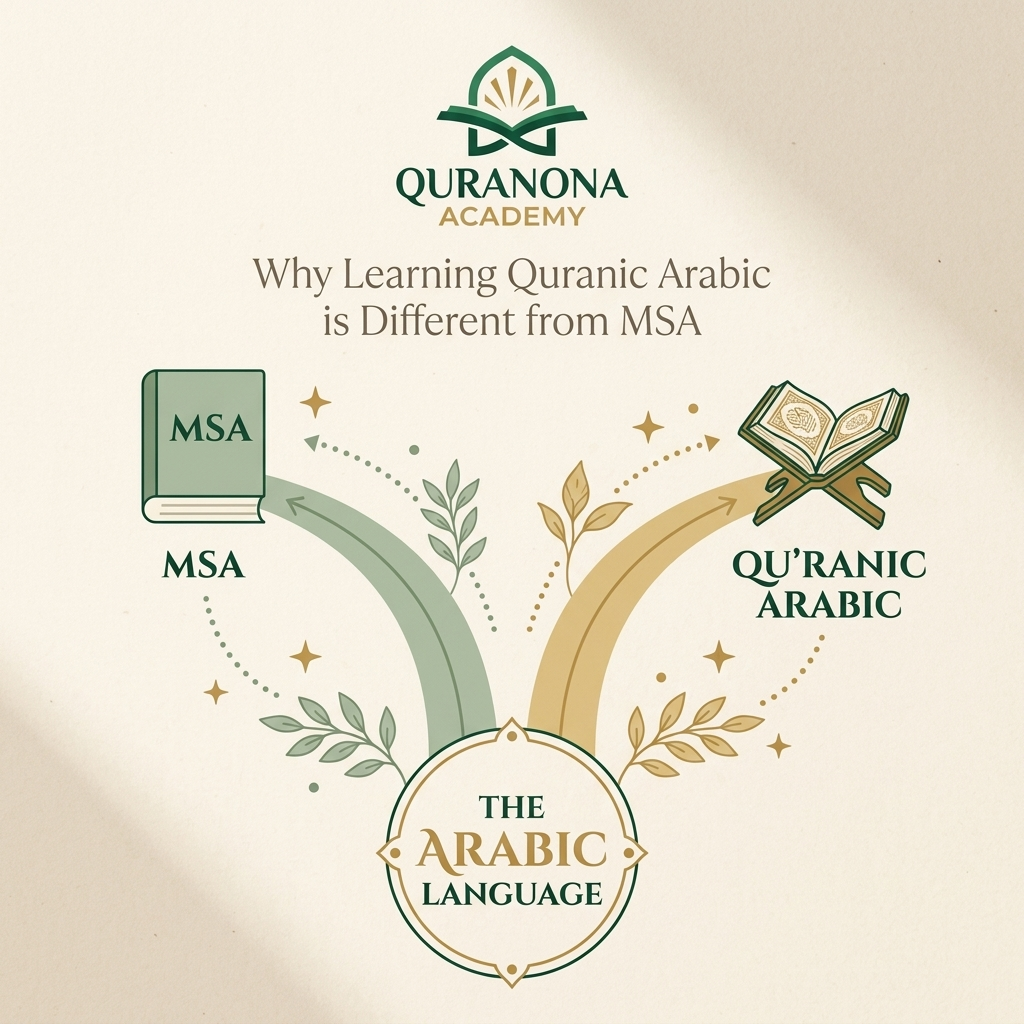
Partially. Someone fluent in MSA will recognize a large share of Quranic vocabulary and grammar, since MSA descended from the same classical roots. However, they will still regularly encounter words, grammatical constructions, and rhetorical patterns that simply don’t appear in modern news Arabic, and will often need a dedicated tafsir or teacher to grasp the full meaning of specific verses.
In practice, this means MSA fluency is a genuine head start, not a finish line, when it comes to understanding the Quran directly in Arabic.
Grammar is actually where the overlap is strongest. Someone who has studied MSA grammar thoroughly, including case endings (i’rab), verb conjugation patterns, and sentence structure, will recognize the same underlying system at work in the Quran. What changes is less the grammar rules themselves and more the vocabulary, the rhetorical devices, and the sheer density of meaning packed into classical sentences compared to a modern news report.
Which Should You Learn First?
The honest answer depends entirely on your goal.
- If your primary goal is understanding the Quran, prioritize Quranic Arabic directly with a teacher who can guide you through vocabulary, grammar, and tafsir together, rather than spending a year or two on MSA news topics first.
- If your goal includes speaking with Arabic speakers, traveling, or reading modern Arabic media, MSA (alongside a dialect) becomes genuinely useful, and the grammar foundation it builds does transfer to Quranic Arabic study later.
- If you want both, many teachers structure a combined path: core grammar first, since it overlaps significantly between the two, and then vocabulary and reading practice split between Quranic texts and modern material based on your interest.
Age and available time matter too. An adult with thirty minutes a day and a clear goal of understanding Salah and daily du’as benefits from a tightly focused Quranic Arabic path far more than a broad MSA curriculum designed for a university semester. On the other hand, a teenager who might use Arabic for travel, media, or future study benefits from a foundation that includes both.
How Learning Quranic Arabic Actually Works
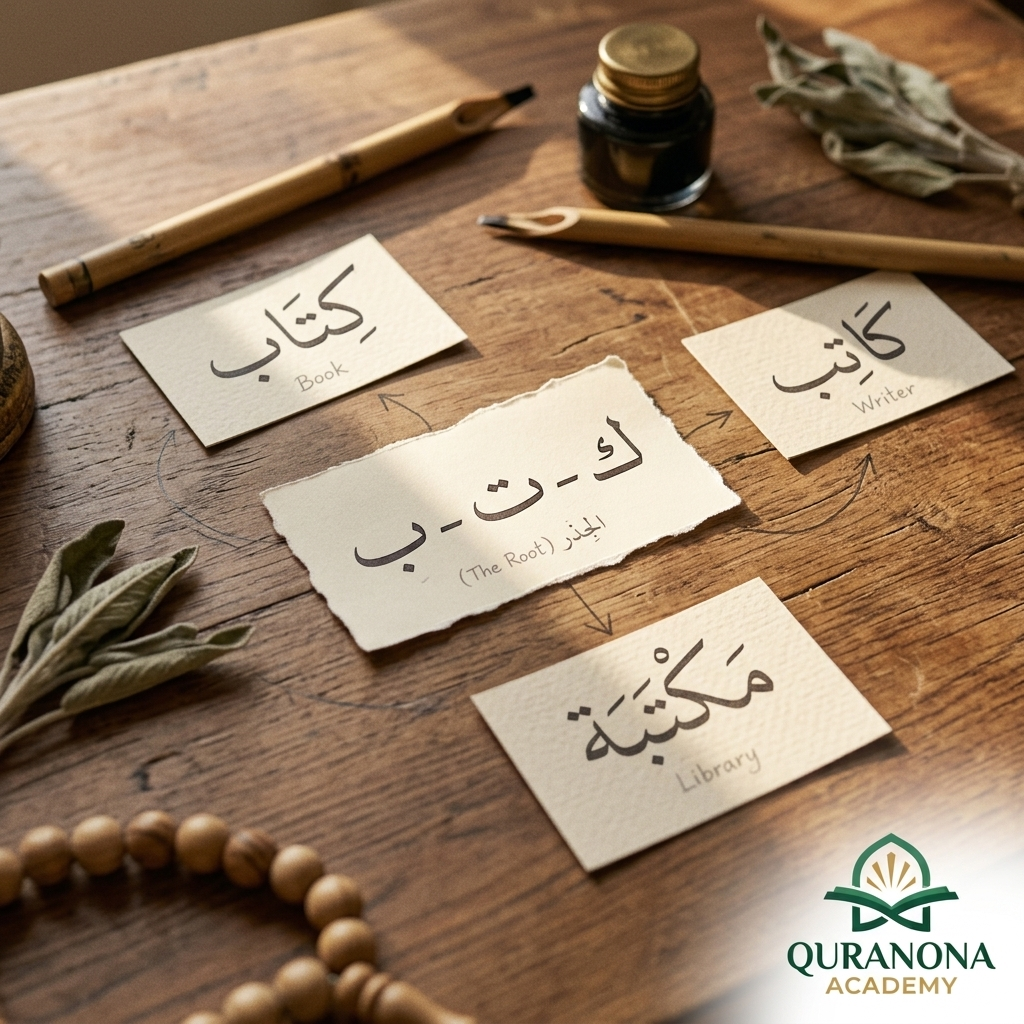
Most structured Quranic Arabic study centers on three things: the root-letter system (most Arabic words trace back to a three-letter root that carries a core meaning), grammar rules specific to how the Quran constructs sentences, and word-by-word study of actual verses rather than generic vocabulary lists.
This approach tends to be more motivating for learners than memorizing MSA vocabulary lists disconnected from anything they personally care about, since every new word or grammar rule immediately connects to a verse they can recognize.
The root-letter system deserves special mention because it’s one of the most efficient shortcuts in Arabic learning. Learning the root ك-ت-ب (k-t-b, related to “writing”) unlocks recognition of related words like كِتَاب (book), مَكْتَب (desk/office), كَاتِب (writer), and كِتَابَة (writing) all at once, since they share the same core meaning with different patterns layered on top. This system works identically in both MSA and Quranic Arabic, which is exactly why grammar study genuinely does transfer between the two forms even when vocabulary doesn’t.
Quranona Academy’s 1-on-1 Arabic classes are built specifically around understanding the Quran, with lessons that connect grammar and vocabulary directly to real verses. Explore a free trial class or message us on WhatsApp.
Common Mistakes Learners Make
- Assuming MSA is a mandatory prerequisite. It’s helpful, not required, especially if your only goal is Quran comprehension.
- Studying vocabulary lists with no connection to real verses. Words learned in isolation tend to be forgotten quickly compared to words encountered in actual Quranic context.
- Expecting Quranic Arabic to feel “simple” because the Quran calls itself clear. Clarity in the classical sense doesn’t mean the vocabulary or structure is basic by modern standards.
- Trying to self-study grammar from books written for native speakers. Structured guidance from a teacher familiar with non-native learners tends to be far more efficient.
Common Misconceptions
“Quranic Arabic and Modern Standard Arabic are basically the same thing.”
They share the same grammatical foundation, but differ meaningfully in vocabulary range, sentence complexity, and literary style, enough that fluency in one doesn’t automatically mean full comprehension of the other.
“You can’t understand the Quran without mastering MSA first.”
Many successful Quranic Arabic learners never pursue MSA fluency at all, focusing their study directly on classical grammar and Quranic vocabulary instead.
“Arabic dialects spoken at home are the same as Quranic Arabic.”
Regional dialects, such as Egyptian or Levantine Arabic, evolved separately for everyday speech and differ significantly from both MSA and Quranic Arabic in vocabulary and grammar, even for native Arabic-speaking households.
Bringing It All Together
Quranic Arabic and Modern Standard Arabic are close relatives, not identical twins. They share a grammatical backbone but serve very different purposes, one built for a single unchanging sacred text, the other standardized for daily modern communication. If your goal is genuinely understanding the Quran, the most direct path is studying Quranic Arabic itself, guided by someone who can connect grammar and vocabulary to real verses from day one.
If you’d like a personalized starting point based on your current level and your goal, you can book a free trial class, visit the Quranona Academy website, or message the team on WhatsApp.
Frequently Asked Questions
Common questions readers ask about Quranic Arabic versus Modern Standard Arabic.
Do I need to learn Modern Standard Arabic before Quranic Arabic?
No. MSA grammar is helpful, but it is not required first. Many learners study Quranic Arabic directly. They focus on grammar, root words, and verses through the Quranic Arabic courses at Quranona Academy.
Is Quranic Arabic harder to learn than Modern Standard Arabic?
Quranic Arabic has rich vocabulary and varied sentence structure. This can feel demanding initially. However, guided verse-by-verse study is often more motivating than memorizing isolated vocabulary lists.
Can native Arabic speakers understand the Quran without extra study?
Native speakers understand general meanings through shared root words. However, full comprehension of classical grammar and deeper nuances still requires dedicated study or tafsir.
Will learning Quranic Arabic help me speak Arabic in daily conversation?
Only partially. Quranic Arabic builds strong grammar foundations. However, daily conversation relies on regional dialects. These dialects differ noticeably from Quranic Arabic and MSA.
How long does it take to read the Quran with basic understanding?
Timeline depends on your weekly study hours. Students in structured programs at Quranona Academy reach basic understanding in 6 to 12 months. Deeper comprehension continues to grow over time.
Is it worth learning Arabic if I can read a translation?
Translations provide basic meanings, but they miss subtle linguistic nuances. Learning basic Quranic Arabic creates a much deeper personal connection to the text.
Have a question that’s not answered here?
Start your learning journey today or talk directly with our academic advisors.
Sources & References
- Quran, Surah Ash-Shu’ara 26:195 — quran.com
This article compares Modern Standard Arabic and Quranic Arabic. These linguistic comparisons rely on widely accepted educational descriptions. They do not represent a specific religious ruling that requires hadith-level verification. Readers interested in deeper classical Arabic grammar may consult recognized academic resources on Nahw and Balaghah.
