


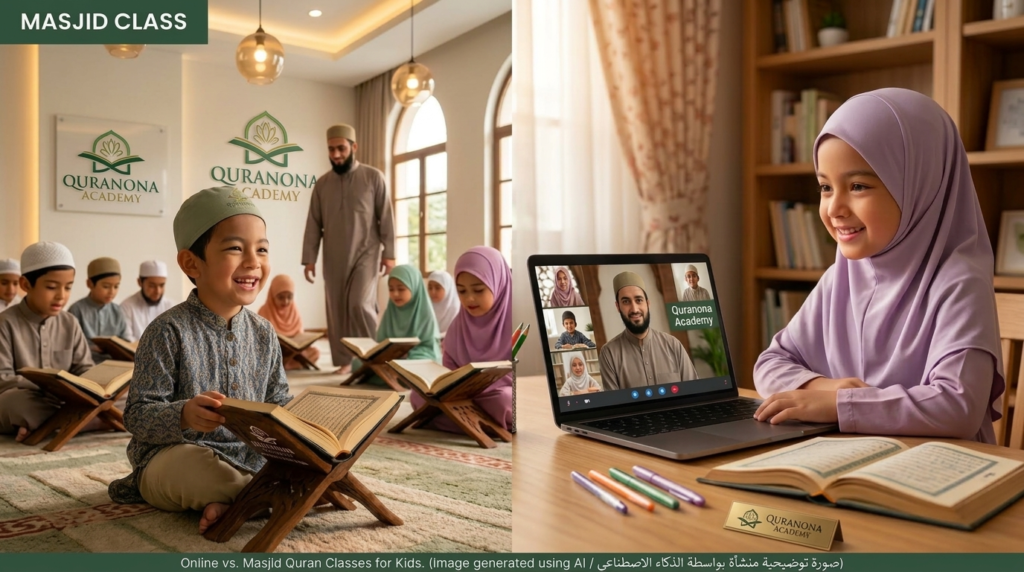
Online vs. Masjid Quran Classes for Kids: An Honest Comparison for Muslim Parents
Every Muslim parent living outside a Muslim-majority country eventually asks the same question: should my child learn Quran at the local masjid, or would an online class actually work better for our family? Both paths can raise a child who loves the Quran. The real difference isn’t which one is “better” in the abstract — it’s which one fits your child, your schedule, and your local community.
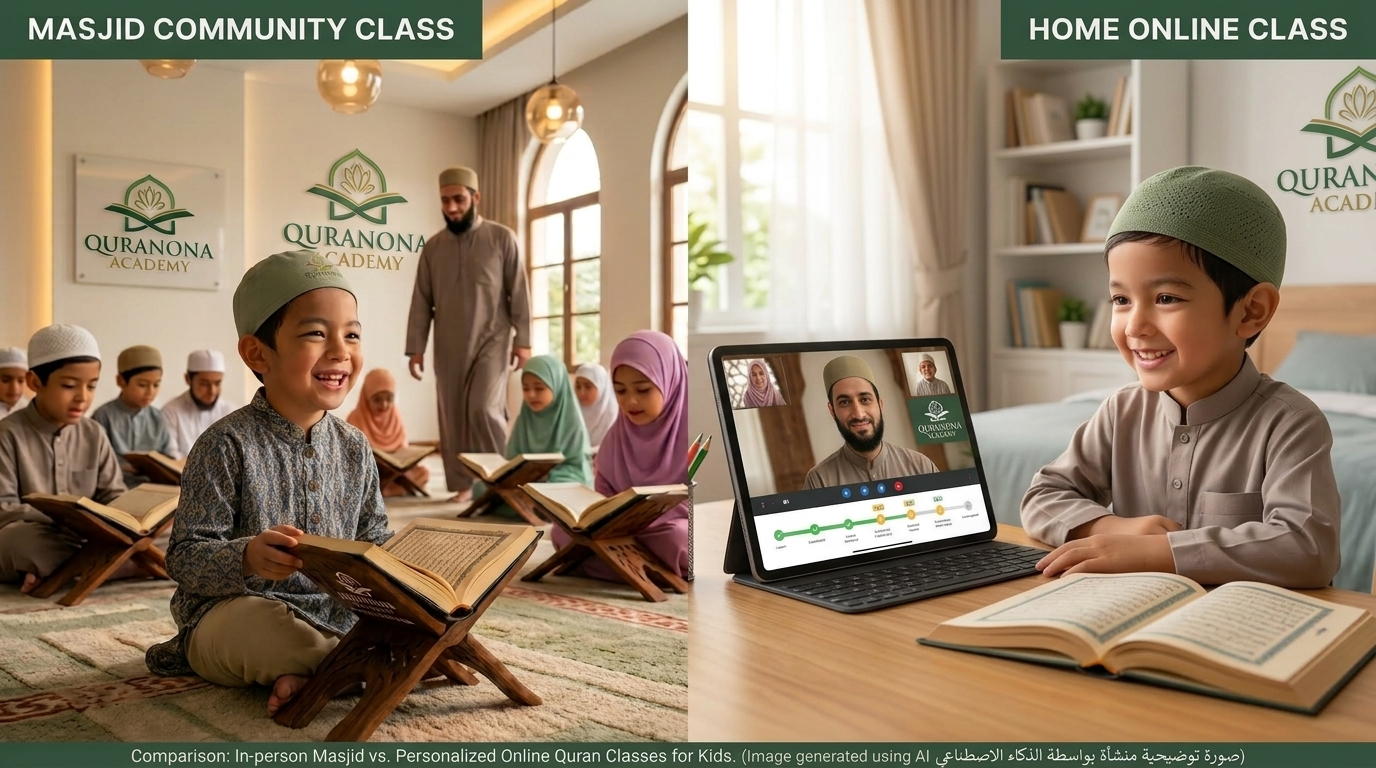
Masjid classes offer in-person community, group learning, and face-to-face accountability, but depend on your local masjid’s schedule, teacher availability, and distance. Online classes offer flexible scheduling, one-on-one attention, and access to qualified tutors regardless of where you live, but require more discipline at home since there’s no physical classroom around your child. Many families find the honest answer isn’t “either/or” — it’s choosing based on what your specific situation actually allows.
What Masjid Quran Classes Do Well
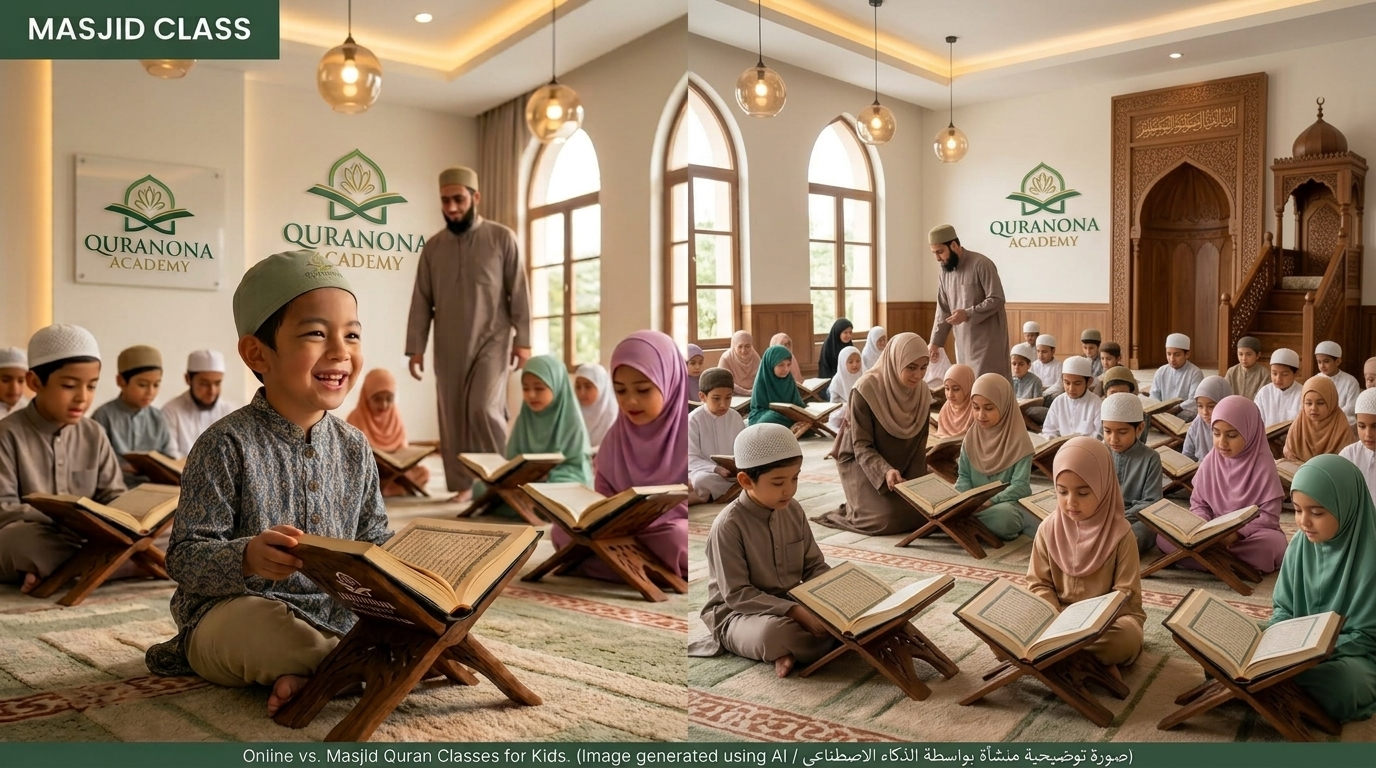
For families who live near an active masjid, in-person classes offer something online learning genuinely cannot replicate on its own: physical presence in a space built for worship and learning. Children see other kids their age reciting, praying, and struggling with the same tajweed rules they are. That shared experience builds a sense of belonging to a community, not just a subject.
Masjid classes also tend to come with built-in structure — a fixed weekly time, a physical building to walk into, and often a broader environment that includes group prayer, holiday gatherings, and interaction with other Muslim families. For younger children especially, that physical routine can make Quran learning feel like a natural part of life rather than “another screen activity.”
Honest Limitations of Masjid Classes
The quality of masjid programs varies enormously and depends almost entirely on what’s available locally. Many masjids run Quran classes as a volunteer effort, with class sizes that can reach 15–20 children per teacher. In a group that size, a shy child or one who needs a slower pace can easily fall behind without anyone noticing for weeks.
Distance and scheduling are the other practical obstacles. Families in smaller cities or rural areas may not have a masjid within a reasonable drive, and even where one exists, class times are fixed and rarely negotiable around a child’s homework load, sports schedule, or a parent’s work shift.
Not sure if a group setting or one-on-one attention would work better for your child? Discover how personalized online Quran learning for kids operates through booking a free trial class to see the interactive approach in action before deciding anything.
What Online Quran Classes Do Well
The clearest advantage of online Quran classes is access. A family in a small town with no masjid, or a family whose nearest Islamic center has no children’s Quran program at all, can still connect their child with a qualified tutor. Scheduling is also far more flexible — sessions can be booked around school, sports practice, or a parent’s work hours rather than the other way around.
One-on-one online sessions allow a tutor to move at the exact pace a specific child needs, repeating a tajweed rule as many times as necessary without holding back a room full of other students, or slowing down a faster learner. For a child who struggles with pronunciation, is easily distracted in groups, or is simply shy, that individual attention can make a real difference in how quickly they progress and how confident they feel.
Have questions about starting one-on-one online sessions?
Get instant guidance from our academic team via WhatsApp regarding schedule availability and tutor matching.
💬 Chat with Us on WhatsAppHonest Limitations of Online Classes
Online classes remove the physical community aspect that a masjid naturally provides. A child doesn’t see other kids reciting around them, and a parent has to work a little harder to build a sense of “this matters” around a screen rather than a building. Without a masjid’s group prayers and gatherings, the social and communal side of learning has to be created deliberately at home — through family Quran time, local community events, or simply attending the masjid for prayers even if classes happen online.
Online learning also depends on a stable internet connection and a quiet space at home, and it requires more parental follow-up than dropping a child off at a class. A parent needs to make sure the child actually shows up, stays focused during the session, and reviews what was taught — responsibilities a masjid’s physical structure partly handles on its own.
يَا أَيُّهَا الَّذِينَ آمَنُوا قُوا أَنفُسَكُمْ وَأَهْلِيكُمْ نَارًا
“O you who believe, protect yourselves and your families from a Fire…”
Scholars have long connected this verse to a parent’s responsibility to actively teach their children the deen, not simply hope they absorb it by proximity to a masjid or a screen. Whichever method a family chooses, the verse is a reminder that the parent’s own involvement — checking in, listening to recitation, praying alongside the child — is what ties the method to the outcome.

Side-by-Side Comparison
| Factor | Masjid Classes | Online Classes |
|---|---|---|
| Community & Social Bonding | Strong — physical presence with peers | Limited — requires effort to build separately |
| Individual Attention | Depends on class size, often limited | Typically one-on-one |
| Scheduling Flexibility | Fixed, set by the masjid | Flexible, set around the family |
| Accessibility | Depends on local masjid availability | Available regardless of location |
| Teacher Consistency | Often volunteer-based, may rotate | Usually a dedicated assigned tutor |
| Parental Involvement Needed | Lower — masjid structure supports it | Higher — parent manages attendance & follow-up |
| Physical Routine | Built-in through walking to the masjid | Must be created at home |
How to Choose What Fits Your Family
There isn’t one right answer for every family, but a few honest questions can narrow it down quickly:
- Is there an active, well-run Quran program at a masjid within reasonable driving distance?
- Does your child do better in a group setting, or do they need individual pacing?
- Can your family commit to a fixed weekly class time, or do you need flexible scheduling around other commitments?
- Are you able to sit with your child during or after online sessions to support their learning, or would a physical classroom’s structure be more realistic for your household right now?
Some families combine both — attending the masjid for community, prayer, and social connection, while using one-on-one online live Tajweed and Quran classes to make sure a specific weak point, like tajweed or memorization pace, gets focused attention.
عَنْ عُثْمَانَ رَضِيَ اللَّهُ عَنْهُ، عَنِ النَّبِيِّ صَلَّى اللَّهُ عَلَيْهِ وَسَلَّمَ قَالَ: «خَيْرُكُمْ مَنْ تَعَلَّمَ الْقُرْآنَ وَعَلَّمَهُ»
“The best among you are those who learn the Quran and teach it.” (Prophet Muhammad ﷺ, narrated by Uthman ibn Affan)
This hadith doesn’t specify a method — a masjid classroom or a video call. It points to what actually matters: that the learning and the teaching happen, sincerely and consistently. That’s the standard worth measuring either option against.
Ready to Explore One-on-One Quran Classes?
Experience how customized pacing and dedicated native Arabic tutors can help your child excel in Tajweed and memorization.
Frequently Asked Questions (FAQs)
Is online Quran learning as effective as learning at the masjid? ▼
It can be, depending on the child and the setup. Online classes often provide more individual attention through one-on-one sessions, while masjid classes provide group structure and community presence. Effectiveness usually comes down to the quality of the teacher and the consistency of practice, not the format itself.
My daughter feels shy in group classes. Would online be better for her? ▼
Many parents find that shy children open up more in a one-on-one setting where they aren’t being compared to classmates in real time. An online tutor can also adjust pace and tone specifically to a quieter child’s comfort level.
Can we do both masjid and online Quran classes together? ▼
Yes, and many families do. Attending the masjid for community, prayer, and social connection while using online one-on-one sessions to focus on a specific need, like tajweed correction or memorization pace, is a common and practical combination.
What should I look for in a good online Quran class for kids? ▼
A dedicated, qualified tutor rather than a rotating one, real one-on-one interaction rather than a large group call, a manageable session length for your child’s age, and regular feedback so you can track actual progress rather than just attendance.
Quranona Academy provides live, one-on-one online classes in Quran, Tajweed, Arabic, and Islamic Studies for non-Arabic-speaking families, taught by qualified native Arabic-speaking tutors.
