



Last Updated: September 9, 2026
Everyone means to do it. The family sits down for dinner, someone mentions it would be nice to read some Quran together more often, everyone agrees, and then the week gets busy and it quietly never happens. If this sounds familiar, the problem isn’t your family’s intention. It’s that “we should read Quran together more” was never turned into an actual plan.
This guide walks through simple, low-pressure ways to build a weekly family Quran routine that survives real family life: different ages, different attention spans, and a schedule that’s already full.
- 1. Why “Family Quran Time” Often Falls Apart Before It Starts
- 2. What the Quran and Sunnah Say About Learning Together
- 3. Before You Start: Setting Expectations for Every Age
- 4. Seven Simple Ways to Bring Your Family Closer to the Quran
- 5. Making It Work With Different Ages Under One Roof
- 6. What to Do When One Family Member Isn’t Interested
- 7. Common Mistakes That Turn It Into a Chore
- 8. When Outside Support Helps
- 9. Common Misconceptions
- 10. Frequently Asked Questions
Why “Family Quran Time” Often Falls Apart Before It Starts
Most families don’t fail because they lack interest. They fail because the plan was vague from the start: “we should do this more” isn’t a routine, it’s a wish. Without a fixed day, a clear activity, and a realistic length, family Quran time competes with homework, sports practice, and simple exhaustion, and it predictably loses.
There’s also a quieter reason it stalls: parents sometimes wait for a moment when everyone is calm, willing, and in the mood, which in a busy household with multiple children rarely arrives on its own. Waiting for the ideal moment is often what prevents the realistic one from ever happening.
A third reason is less obvious: many parents assume “family Quran time” has to look like a mini classroom, with a lesson plan and a clear educational objective for the evening. That expectation alone can make the whole idea feel intimidating enough to keep postponing. In reality, the version that actually survives long-term in most homes looks much closer to a relaxed family conversation than a structured class.
What the Quran and Sunnah Say About Learning Together
Islamic teaching places real weight on gathering as a family and as a community around the Quran, not just on individual reading alone.
Hadith
Abu Hurairah (may Allah be pleased with him) reported that the Prophet ﷺ said: “…those who assemble in one of the houses of Allah, reciting the Book of Allah and studying it among themselves, will have tranquility descend upon them, mercy envelop them, the angels surround them, and Allah will mention them among those near Him.”
Source: Sahih Muslim 2699
While this hadith is often applied to gatherings in the mosque, the principle of collective benefit from studying the Quran together applies naturally to a family gathered at home around the same purpose.
Quran, Surah At-Tahrim 66:6 (partial)
يَا أَيُّهَا الَّذِينَ آمَنُوا قُوا أَنفُسَكُمْ وَأَهْلِيكُمْ نَارًا
“O you who have believed, protect yourselves and your families from a Fire…”
Classical commentators, including in the tafsir of Ibn Kathir, explain this verse as a direct instruction for the head of a household to actively teach and guide the family in obedience to Allah, not simply to focus on personal worship alone. Weekly family Quran time is one practical way of fulfilling that responsibility consistently, rather than leaving it to chance.
Hadith
Abdullah ibn Umar (may Allah be pleased with him) reported that the Prophet ﷺ said: “Each of you is a shepherd and each of you is responsible for his flock… A man is the shepherd of his household and is responsible for them.”
Source: Sahih al-Bukhari 7138, Sahih Muslim 1829
This hadith frames guiding the family’s connection to the Quran as a genuine responsibility, not an optional extra reserved for especially motivated weeks.

If you’d like personalized guidance on building a family routine, you can book a free trial class with Quranona Academy.
Before You Start: Setting Expectations for Every Age
A few honest expectations up front prevent most early disappointment.
- Fifteen to twenty minutes is enough, especially with young children. Longer sessions are more likely to end in restlessness than reflection.
- Not every week will go smoothly. Some weeks the toddler will be uninterested and the teenager will be distracted, and that’s a normal part of family life, not evidence the routine isn’t working.
- The goal is connection, not a perfect lesson. This isn’t a formal class; it’s a shared family habit built around the Quran.
It also helps to keep the setup itself simple. You don’t need a special room, a printed curriculum, or matching notebooks for everyone. A mushaf, a translation you’re comfortable reading from, and a quiet corner of the living room are enough to start. Overcomplicating the setup is one of the quieter ways families talk themselves out of starting at all.
Seven Simple Ways to Bring Your Family Closer to the Quran
1. Set a Weekly Family Quran Night
Pick one evening, such as Thursday or Sunday, and treat it like any other recurring family commitment. A fixed day removes the need to negotiate timing every single week.
2. Choose a Verse of the Week
Instead of moving quickly through pages, pick one short verse or a small cluster of verses to sit with for the entire week. This gives everyone, including younger children, a chance to actually absorb it rather than rushing past it.
3. Take Turns Reading Aloud
Rotate who reads each week, including children old enough to read a few words. Being an active participant rather than only a listener tends to increase genuine engagement.
4. Connect the Verse to Real Life
Spend a few minutes asking a simple question: “Did anything happen this week that reminds you of this verse?” This is often where the most memorable family conversations happen, far more than the reading itself.
5. Keep a Simple Family Reflection Journal
A shared notebook where each person writes one sentence about the week’s verse, even just a few words for younger children, creates a growing record the family can look back on together after a few months.
6. Give Younger Children a Role Suited to Them
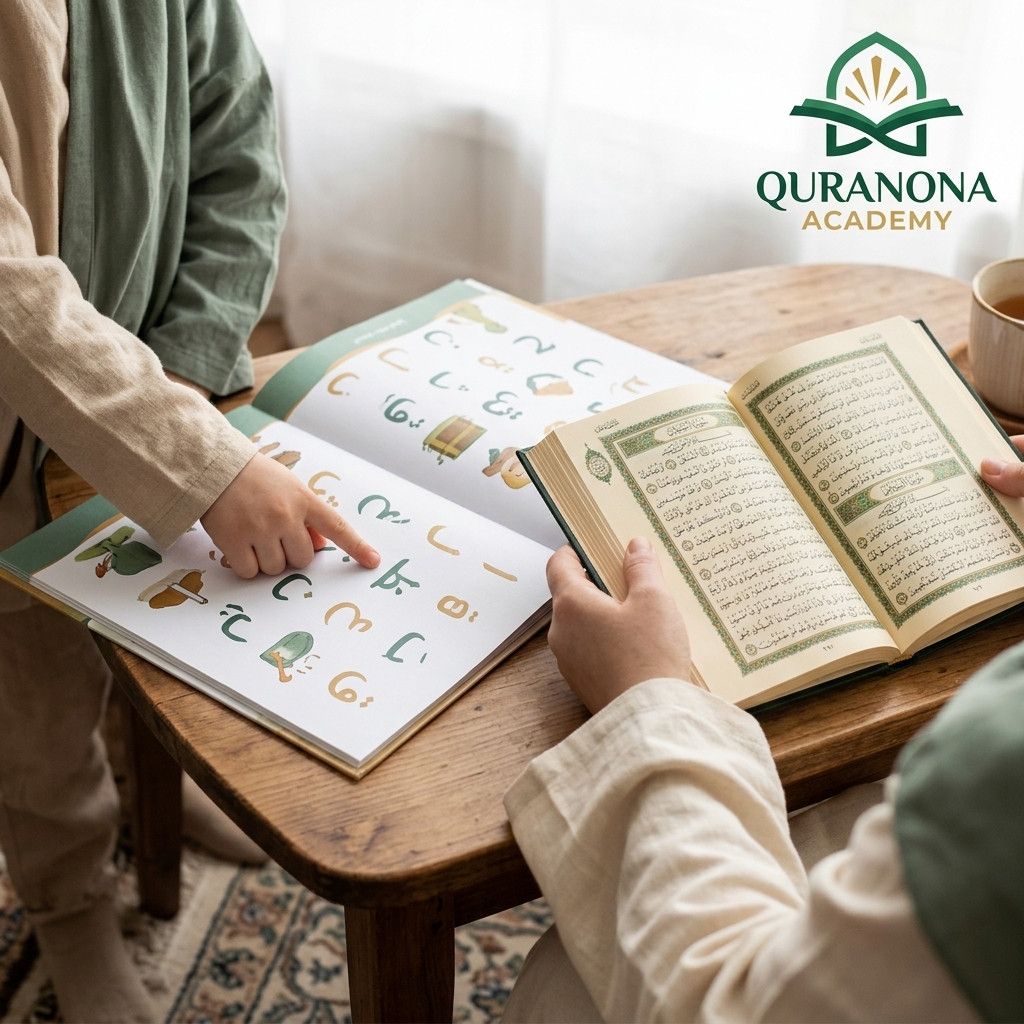
A child too young to read can still repeat a short phrase after a parent, hold the mushaf, or draw a picture related to the verse’s meaning. Involvement doesn’t require reading ability.
7. Keep the Atmosphere Warm, Not Test-Like
Avoid turning the session into a quiz or a correction session for mistakes. The tone should feel closer to a family conversation than a classroom evaluation.
These seven ideas aren’t meant to all be used every single week. Many families rotate through two or three of them, such as always doing a Verse of the Week combined with taking turns reading, and saving the reflection journal for weeks when there’s a bit more time. Treat this as a menu to pick from rather than a checklist to complete in full each time.

Making It Work With Different Ages Under One Roof
| Age Group | Suggested Role |
|---|---|
| Toddlers and preschoolers | Listen and repeat a short phrase; hold the mushaf; simple drawing related to the verse |
| Early elementary | Read one short verse aloud with help; share one sentence in the reflection journal |
| Older children and teens | Read a full verse or two independently; lead the discussion question some weeks |
| Parents | Facilitate, model genuine reflection, and keep the tone warm rather than instructional |
Rotating who leads the discussion question, including letting older children take a turn, often increases investment across the whole family.
What to Do When One Family Member Isn’t Interested
It’s common, especially with teenagers or a reluctant spouse, for one person to show little enthusiasm at first. Pressuring participation through guilt tends to backfire, making the activity feel like an obligation to escape rather than something to look forward to.
A more effective approach is consistent, low-pressure invitation: keep the session happening whether or not everyone is fully engaged that week, keep the tone warm, and avoid singling anyone out for their lack of enthusiasm in front of the family. Interest often develops gradually once the activity feels safe rather than mandatory.
Common Mistakes That Turn It Into a Chore
- Making sessions too long. Thirty or forty minutes with young children usually ends in restlessness rather than reflection.
- Correcting every mistake during reading. This can make children dread their turn instead of look forward to it.
- Treating it as a lesson to be tested on. Family Quran time works best as connection, not evaluation.
- Skipping weeks without rescheduling. One skipped week easily becomes a forgotten routine if it isn’t picked back up quickly.
- Only involving some family members. Leaving out very young children or an uninterested teenager from any role at all makes it harder for them to feel part of it later.
It’s worth noting that most of these mistakes come from good intentions taken slightly too far, wanting the session to be thorough, accurate, and meaningful. Scaling ambition back slightly, at least in the first few months of building the habit, tends to produce a routine that actually lasts rather than one that burns out by the third week.
When Outside Support Helps
Family time builds connection and consistency, but it isn’t a substitute for structured learning, particularly for correcting recitation and building reading skills properly. Many families find it works well to keep family Quran night focused purely on connection and reflection, while individual skill-building, such as Tajweed and memorization, happens separately with a qualified teacher.
Quranona Academy offers 1-on-1 live online classes for children and adults, so each family member can build their individual skills at their own pace alongside your family’s shared routine. Explore a free trial class or message the team on WhatsApp.
Common Misconceptions
**Sources & References**– Quran, Surah At-Tahrim 66:6 — quran.com/66/6 – Sahih Muslim, Hadith 2699 (narrated by Abu Hurairah) — sunnah.com/muslim:2699 – Sahih al-Bukhari, Hadith 7138; Sahih Muslim, Hadith 1829 (narrated by Abdullah ibn Umar) — sunnah.com/bukhari:7138**About Quranona Academy** Quranona Academy offers 1-on-1 live online Quran, Tajweed, Arabic, and Islamic Studies classes for children and adults, taught by qualified native Arabic-speaking teachers, for Muslim families in the US, Canada, UK, Australia, and beyond.Frequently Asked Questions
How long should weekly family Quran time last?
There’s no fixed length. Fifteen to twenty minutes is realistic for most families with young children, and can grow longer over time. Consistency matters more than duration.
What if my kids are different ages and it’s hard to keep everyone engaged?
Give each age group a role suited to them, such as younger children listening and repeating while older children read aloud. Rotating roles weekly also helps keep things fresh.
What if one family member really isn’t interested?
Avoid forcing participation through pressure or guilt. Keep inviting them consistently, keep the atmosphere warm, and give it time. Interest often grows once it feels unpressured.
Do we need to read in Arabic, or is translation okay?
Translation is completely fine for family discussion and connection. Many families combine a short Arabic portion with a translation to make sure everyone understands the meaning.
What’s a good day of the week for family Quran time?
Many families choose a weekend evening or right after Maghrib on a specific day, since it’s easier to protect consistently than relying on finding time during busy weekdays.
