



Table of Contents
- 1. Introduction: Why “More Verses” Isn’t Always Better
- 2. Setting Realistic Expectations for Children
- 3. Core Readiness Skills Before Starting
- 4. Essential Principles of Effective Memorization
- 5. Overview: The 12-Month Juz’ Amma Roadmap
- 6. The 12-Month Plan, Month by Month
- 7. A Daily and Weekly Rhythm That Actually Works
- 8. Review (Muraja’ah): The Step Families Skip
- 9. Keeping Motivation High Without Over-Rewarding
- 10. Common Pitfalls and How to Avoid Them
- 11. Frequently Asked Questions (FAQ)
- 12. Conclusion & Next Steps
1. Introduction: Why “More Verses” Isn’t Always Better
Many parents begin their child’s Quran memorization journey with immense enthusiasm. They set ambitious targets, hoping their child will memorize several pages a week or finish entire sections in a few months. However, pushing for speed often leads to quick burnout, poor pronunciation, and weak retention.
A successful Quran memorization plan for kids is not built on speed; it is built on consistency, proper Tajweed, and structured review. A child who memorizes two lines a day with deep retention and joy will far outpace a child who memorizes a page a day only to forget it a month later.
2. Setting Realistic Expectations for Children
Children learn differently based on age, attention span, and language background. Expecting a six-year-old to sit for an hour of intense memorization is counterproductive. Understanding what is realistic prevents frustration for both parent and child.
| Age Group | Daily Session Time | Target Pace | Primary Focus |
|---|---|---|---|
| Ages 4–6 | 10–15 minutes | 1–2 short verses / day | Listening, repetition, basic pronunciation |
| Ages 7–9 | 20–30 minutes | 3–5 verses / day | Reading accuracy, Tajweed, basic meanings |
| Ages 10–12 | 30–45 minutes | Half a page / day | Independent recitation, structured review |
3. Core Readiness Skills Before Starting
Before launching into a formal memorization schedule, ensure your child has developed these foundational prerequisites:
- Arabic Letter Recognition: The child should recognize Arabic letters and basic vowel markings (Fatha, Kasra, Damma).
- Correct Audio Familiarity: Regular exposure to clear Quran recitation builds natural rhythm and phonetics.
- Established Routine: A daily 15-minute slot already integrated into the family’s schedule.
4. Essential Principles of Effective Memorization
Adhering to proven principles makes memorization smoother and more durable:
- Quality Over Quantity: Memorizing one verse correctly is better than memorizing five with mistakes.
- Listen Before Reciting: Always have the child listen to a qualified reciter 3–5 times before attempting to memorize.
- Never Skip Muraja’ah (Review): Old memorization must be reviewed daily before adding new verses.
- One Mushaf Rule: Use the exact same printed or digital Quran layout to leverage visual memory.
5. Overview: The 12-Month Juz’ Amma Roadmap
Juz’ Amma (the 30th part of the Quran) contains 37 short Surahs. It is the traditional starting point for children. This 12-month schedule breaks down Juz’ Amma into manageable quarters, incorporating built-in review periods to prevent memory decay.
6. The 12-Month Plan, Month by Month
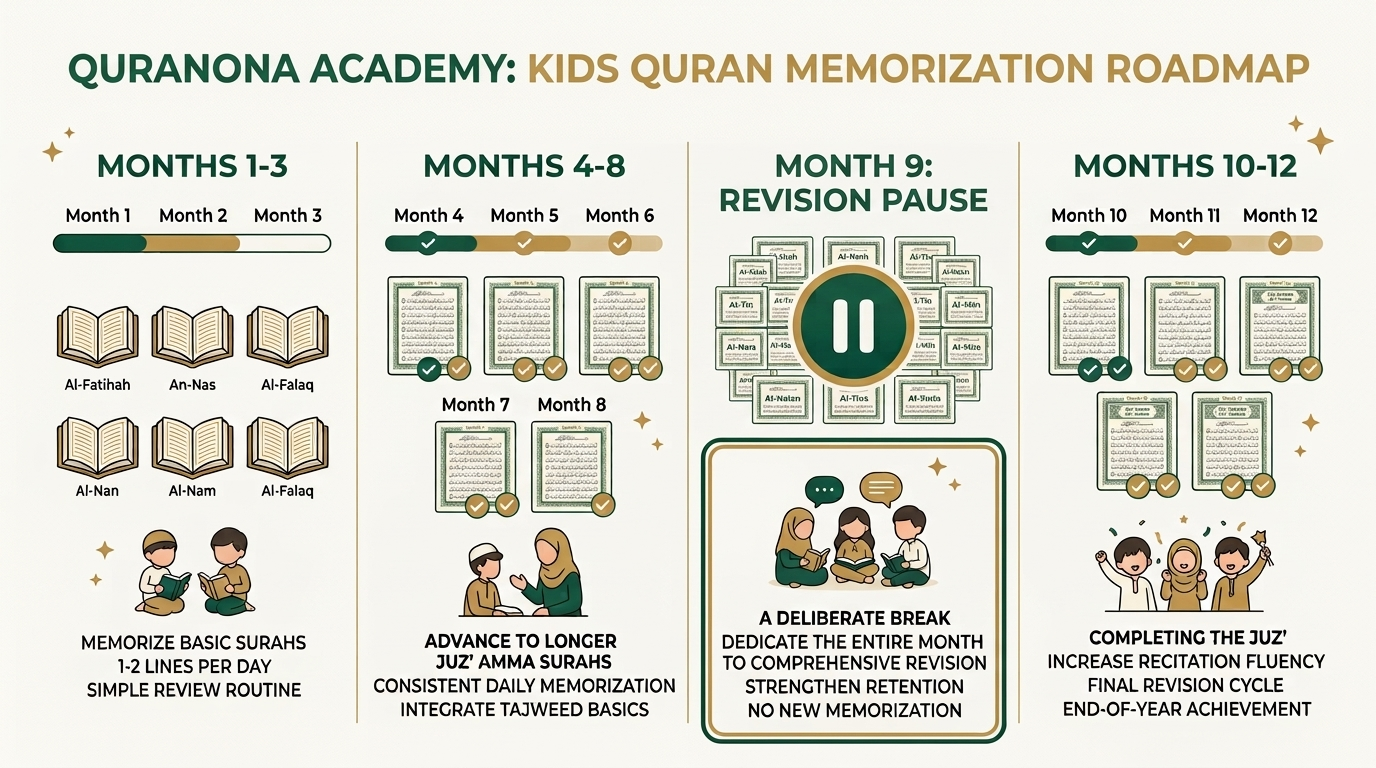
Below is the structured breakdown for each phase of the 12-month schedule:
Months 1–3: Building Foundations (Shortest Surahs)
Focus on short Surahs to build confidence and establish a daily habit.
- Month 1: Surah Al-Fatiha, An-Nas, Al-Falaq, Al-Ikhlas, Al-Masad
- Month 2: Surah An-Nasr, Al-Kafirun, Al-Kawthar, Al-Ma’un, Quraysh
- Month 3: Surah Al-Fil, Al-Humazah, Al-Asr, At-Takathur
Months 4–8: Building Momentum (Mid-Length Surahs)
Transition to slightly longer Surahs while reinforcing daily review routines.
- Month 4: Surah Al-Qari’ah, Al-Adiyat, Az-Zalzalah, Al-Bayyinah
- Month 5: Surah Al-Qadr, Al-Alaq, At-Tin, Ash-Sharh
- Month 6: Surah Ad-Duha, Al-Layl, Ash-Shams
- Month 7: Surah Al-Balad, Al-Fajr
- Month 8: Surah Al-Ghashiyah, Al-A’la, At-Tariq
Month 9: The Crucial Pause (Consolidation Month)
Zero new memorization! Dedicated entirely to strengthening everything memorized in Months 1–8. This pause prevents cumulative forgetting.
Months 10–12: Completing Juz’ Amma
Finish the longest Surahs in the Juz’ with a strong focus on fluency and Tajweed.
- Month 10: Surah Al-Buruj, Al-Inshiqaq, Al-Mutaffifin
- Month 11: Surah Al-Infitar, At-Takwir, Abasa
- Month 12: Surah An-Nazi’at, An-Naba’ + Final Comprehensive Review
7. A Daily and Weekly Rhythm That Actually Works
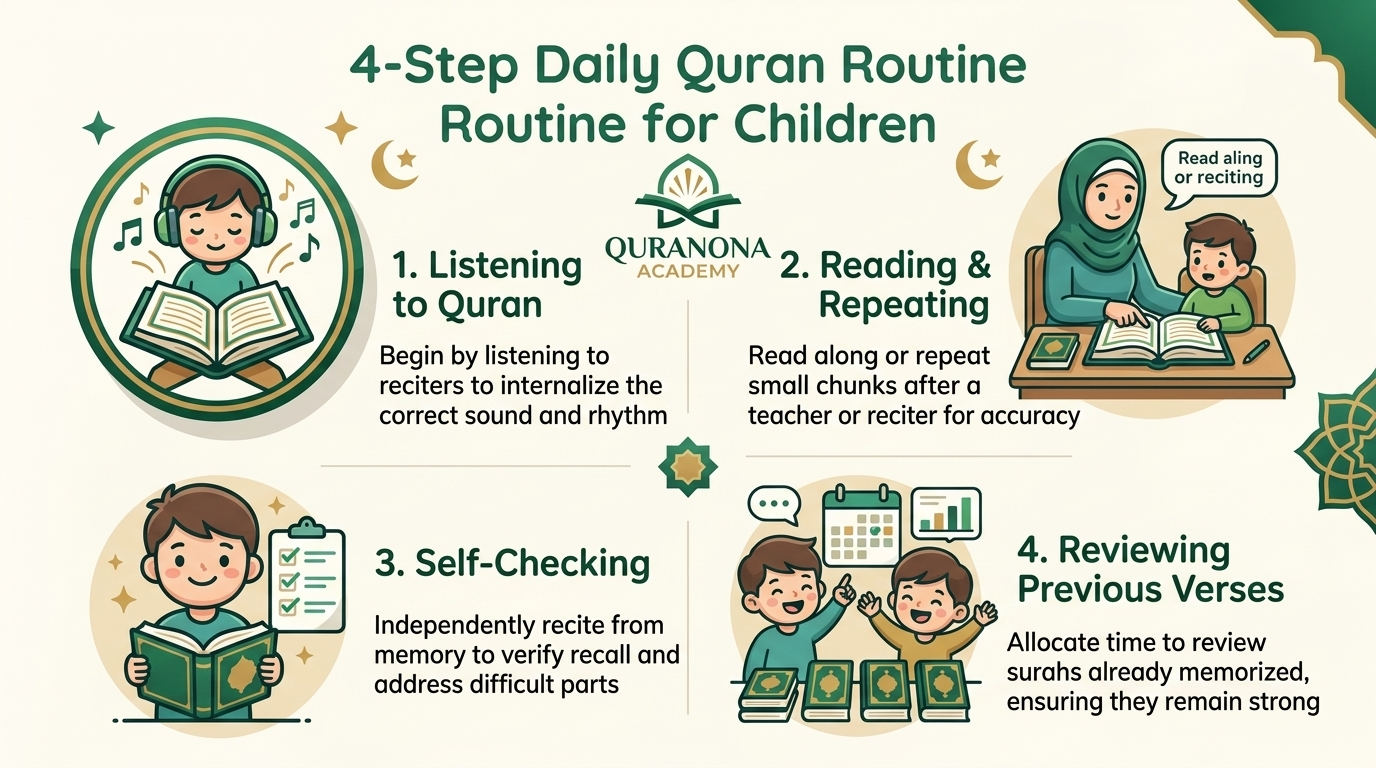
Consistency is built through a structured daily session. Keep daily sessions between 15 and 20 minutes for optimal focus:
- Step 1: Listen First (3 mins): Listen to the target verse 3–5 times from a clear reciter.
- Step 2: Repeat in Chunks (5 mins): Recite line by line after the teacher or parent.
- Step 3: Self-Check (3 mins): Recite from memory without looking at the page.
- Step 4: End with Review (4 mins): Recite yesterday’s Surah to build retention.
8. Review (Muraja’ah): The Step Families Skip

The biggest mistake in Quran memorization is neglecting review. Use a 3-tier rolling review system:
- Daily Review: Current week’s new verses + previous week’s Surah.
- Weekly Review: All Surahs memorized during the current month.
- Monthly Review: Cumulative check of ALL Surahs memorized so far.
9. Keeping Motivation High Without Over-Rewarding
Maintaining long-term enthusiasm requires a balance of intrinsic and extrinsic motivation:
- Visual Progress Trackers: Use sticker charts or colored progress maps.
- Milestone Celebrations: Celebrate completing major sections (e.g., family dinner after completing Month 3).
- Connect with Stories: Share brief, age-appropriate explanations of the Surah meanings to build spiritual connection.
10. Common Pitfalls and How to Avoid Them
| Common Mistake | Why It Harms Progress | Better Alternative |
|---|---|---|
| Comparing siblings | Causes insecurity and resentment | Celebrate individual effort and consistency |
| Skipping Tajweed basics | Hard to unlearn incorrect pronunciation later | Teach correct Tajweed from day one |
| Irregular schedules | Leads to rapid forgetting and frustration | Short daily sessions (15 mins) every day |
11. Frequently Asked Questions (FAQ)
Q: What if my child forgets a Surah they previously memorized?
A: Forgetting is a natural part of learning. Pause new memorization for 3–5 days and focus exclusively on re-strengthening that Surah using audio-assisted repetition.
Q: How many days a week should we practice?
A: 5 days of new memorization + review, 1 day of review only, and 1 full rest day per week works best for long-term consistency.
Q: Should non-Arabic speaking children learn Tajweed from the start?
A: Yes. Correct pronunciation (Makharij) must be practiced from the beginning. It is much harder to correct mispronounced words once they are memorized.
12. Conclusion & Next Steps
Memorizing the Quran is a lifelong journey. A structured 12-month schedule provides clarity, prevents burnout, and ensures your child builds a joyful, lasting relationship with the Quran.
Start Your Child’s Quran Journey with Expert Guidance
Help your child memorize Juz’ Amma with correct Tajweed under the guidance of certified Arabic & Quran tutors.
Book a Free Trial Class